www.willner.com • 1-800-633-1106
* These statements have not been evaluated by the Food and Drug Administration.
These products are not intended to diagnose, treat, cure, or prevent any disease.
© 2011 New Chapter, Inc.
Bone & Joint Health…
Naturally
Every year, 2 million new fractures occur, 300,000 people are
hospitalized, and 19 billion dollars in direct healthcare costs are
spent as a result of bones that have lost density and strength.
Understanding Bone Strength
Bone is a mineralized living tissue that is constantly being broken down
and rebuilt or remodeled. In fact, the body grows the equivalent of an
entirely new skeleton every seven years. There are two main types of
cells that are crucial to bone remodeling – osteoblasts, and osteoclasts.
The job of osteoblasts is to build new bone, and the job of osteoclasts
is to break down bone. In healthy bone tissue, osteoblasts and osteo-
clasts work in balance with one another, routinely breaking down bone
when needed by the body, and then rebuilding bone tissue to replace
and strengthen the bone. When bone remodeling begins to favor break
down of bone by osteoclasts over bone formation by osteoblasts, bone
strength may be afected.
Everyone Is at Risk for Bone Loss
It is a common misconception that only older women need to worry
about bone loss. In fact, both men and women will begin to lose 0.5-1%
of their bone density or degree of bone mineralization per year starting
around age 30.
Calcium is a critical mineral that is important not only for bone
and joint health, but one that also aids muscle and nerve function,
blood pressure regulation, blood clotting, cellular health, and the
release of certain hormones. Not surprisingly, given this vital role,
the body maintains a constant level of calcium in the bloodstream. To
support this constant level, our bones also act as a storage bank for
calcium. If blood calcium levels are low due to dietary intake, calcium
is taken from our bones and used by the body. Over time, this can
negatively afect bone density.
A healthy infammation response may also contribute to the
control of bone changes that can cause discomfort and compromise
the integrity of the joint. When the infammation response is out of
balance, joint health may be complicated, in most cases, with chal-
lenges to bone and soft tissue in the joint. Therefore, maintaining a
healthy infammation response is also vital for optimal bone and joint
health.* Our bodies understand and seek whole food sources of nutri-
tion, which is why New Chapter ofers a whole-food approach to bone
and joint health.
Calcium Isn’t the Only Nutrient
Needed to Help Prevent Bone Loss
Bone is a living tissue made up of more than just calcium, and calcium
does not function in isolation. Other vitamins and minerals play a
major role in determining whether the calcium you ingest will actually
be absorbed and properly utilized by the bones.
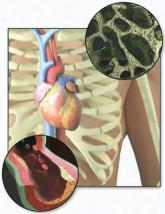
The Calcium Paradox
Without adequate
vitamin K, calcium will
not be deposited in
the bones where it is
required for maintain-
ing bone strength,
but rather in the
arteries where it can
severely compromise
cardiovascular health.*
Another vitamin
critical for calcium
absorption and utiliza-
tion is vitamin D3.
Individuals who are
defcient in vitamin D3
absorb about one half
the amount of calcium
as individuals who
maintain sufcient
vitamin D3 levels.
Magnesium and trace
minerals like silica,
vanadium, boron, and strontium have also been shown to be essential
for the normal growth and development of skeletons in humans and
animals, and should be included in a bone health nutritional program.
Lack of calcium in the
bones makes them
porous and brittle.
Excess calcium
in vessel walls
impedes blood fow.
FALL11fl080411WC.indd 4
8/11/11